
Buying Guide
Undercounter Refrigerators Buying Guide
Doors vs. drawers and section count matched to a specific station – undercounter trades capacity for footprint, on purpose.
What Matters Most
Vs. reach-in
Undercounter fits under the counter and holds less; reach-in stands alone and holds more.
Doors vs. drawers
Doors hold more per section; drawers give faster access during a busy shift.
Sizing
Size to what the station itself needs at hand, not your kitchen total storage need.
Fit check
Confirm exact height, depth and door-swing clearance against your existing counter run.
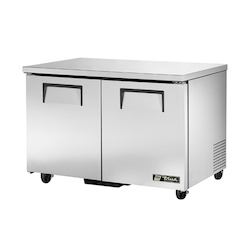
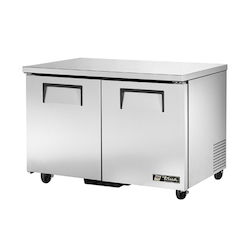
An undercounter refrigerator fits below a prep counter or workstation, putting cold storage exactly where a station needs it without taking up separate floor space. The buying decision comes down to door count, door style, and how the unit fits your existing counter run.
How undercounter differs from reach-in
An undercounter refrigerator is built to fit under a standard counter height, typically around 32 to 36 inches tall, where a reach-in refrigerator stands as a full, separate floor unit. The tradeoff is capacity for footprint – an undercounter unit holds meaningfully less than a reach-in, but adds cold storage to a station without using any additional floor space. Choose undercounter when the point is proximity to a specific workstation, not when the point is maximum storage volume.
Doors vs. drawers
Solid doors are the standard, lower-cost configuration and hold more per section than drawers of the same width. Drawers give faster access to backup stock at a specific station without swinging open a full door, useful on a line where staff reach in constantly during service, but cost more and hold somewhat less per linear foot. Match this to how often the unit actually gets opened during a shift.
Sizing and section count
Undercounter refrigerators are commonly sized in one, two, or three-section runs to match standard counter lengths. Size to what the specific station actually needs stored at hand – backup prep items, sauces, portioned proteins – not to your kitchen’s total refrigerated storage need, since that belongs on a reach-in or walk-in rather than a station-level undercounter unit.
Placement and integration
Check the exact height, depth and door-swing clearance against your existing counter run before ordering – undercounter units are meant to integrate into a specific counter, so a mismatch is a bigger problem here than it would be with a standalone reach-in. Confirm ventilation clearance around the compressor as well, since a boxed-in undercounter unit needs airflow to run efficiently.
Temperature range and food safety
An undercounter refrigerator needs to hold product in the refrigerated range required by food-safety regulations in your jurisdiction, the same standard that applies to any commercial refrigeration – check your local health authority requirements and confirm the specific model rated range meets it.
New vs. used
A used undercounter refrigerator can be a practical way to add station-level cold storage without full new-equipment cost, provided the compressor and door gaskets are in good condition. Husky Select pre-owned equipment is inspected before listing and carries an added 30-day Husky warranty on top of whatever service life remains on the unit.
Financing, Delivery & Warranty
Once you know what you need, Husky can help with financing, coordinate delivery, and stands behind every purchase with real warranty support.
Frequently Asked Questions
What is the difference between an undercounter and a reach-in refrigerator?
An undercounter unit fits under a standard counter height and adds cold storage to a station without using floor space, at the cost of holding meaningfully less than a reach-in. Choose undercounter for proximity to a specific workstation, reach-in for maximum storage volume.
Should I get doors or drawers?
Doors are the standard, lower-cost configuration and hold more per section. Drawers give faster access without opening a full door, useful on a line where staff reach in constantly during service, but cost more and hold somewhat less. Match this to how often the unit actually gets opened.
How do I size an undercounter refrigerator?
Size to what the specific station actually needs stored at hand – backup prep items, sauces, portioned proteins – not your kitchen entire refrigerated storage need, which belongs on a reach-in or walk-in.
What should I check before ordering?
Confirm exact height, depth and door-swing clearance against your existing counter run, since undercounter units are meant to integrate into a specific space. Also confirm compressor ventilation clearance, since a boxed-in unit needs airflow to run efficiently.
Is a used undercounter refrigerator a good option?
It can be, provided the compressor and door gaskets are in good condition. Husky Select pre-owned equipment is inspected and carries an added 30-day Husky warranty on top of whatever service life remains on the unit.
Ready to Buy?
Tell Husky what you need and get a quote — for one unit or a full kitchen package.